London Children’s Lung Health Improves After Clean Air Measures
A new study has found encouraging evidence that reducing air pollution can help children’s lungs grow and recover.
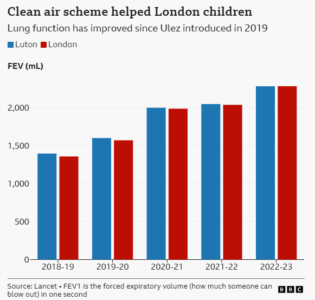
Researchers followed more than 3,400 primary school children in London and Luton for five years. They found that children living in London, whose lung growth had initially been affected by pollution, experienced faster lung growth after the introduction of London’s Ultra Low Emission Zone (Ulez).
The researchers say they were surprised by how quickly the children’s lung capacity improved.
What did the study find?
Children aged between six and nine were given lung function tests every year. Researchers compared children living in London with children of similar backgrounds living in Luton.
At the beginning of the study, the London children had smaller lung capacity than those in Luton.
Over the following four years, however, the London children’s lung growth accelerated. By the end of the study, their lung capacity was almost the same as that of the children in Luton.
The proportion of London children with clinically impaired lung capacity also fell from 14% to 9%.
Researchers also recorded a faster reduction in exposure to nitrogen dioxide in London, suggesting that improvements in air quality may have played an important role.
Why does this matter?
Children are particularly vulnerable to air pollution because their lungs and immune systems are still developing.
Poor air quality can affect lung growth and has been linked to conditions including asthma and other long-term health problems.
The findings suggest that cleaner air could give children’s developing lungs a better chance to grow normally.
Professor Chris Griffiths from Queen Mary University of London described the speed of improvement as surprising and said the results show that ambitious clean air measures can make a difference.
More research is still needed
Researchers and independent experts say the results are promising, but there are other factors to consider.
For example, children in London may have walked or cycled more after Ulez was introduced. The Covid-19 pandemic also affected people’s behaviour and levels of pollution during the study period.
Experts say studies in other cities would help confirm the findings.
There is also a reminder that air pollution remains a problem. Despite improvements, pollution levels in London, Luton and other UK cities are still above recommended levels.
A positive message for children’s health
The study provides strong evidence that reducing pollution could have important benefits for children’s health.
With more than a billion children living in cities around the world, many of them exposed to polluted air, the researchers believe the findings could have significance far beyond London.
Clean air isn’t just about the environment, it could also be an important investment in children’s health and their future.
Source: BBC News report